
A Roman temple in the middle of town, a chapel lined with bones, a cathedral roof you can walk on and a stone circle older than Stonehenge: Évora packs two thousand years of history into a compact, walkable walled city. And in 2027 it becomes a European Capital of Culture.
An easy drive or train ride east of Lisbon, Évora rises gently out of the wide plains of the Alentejo, a landscape of cork oaks, olive groves and golden fields. Inside its old walls, whitewashed lanes edged in ochre lead to arcaded squares, Roman columns and quiet cloisters. The whole historic centre is a UNESCO World Heritage Site, yet it never feels like a museum: this is a lively university town where families still sit outside on warm evenings.
For families, Évora is ideal. The distances are short, the sights are varied enough to keep children curious, and the pace of life is wonderfully slow.
Évora 2027: European Capital of Culture
Évora has been named European Capital of Culture for 2027, alongside Liepāja in Latvia. It is only the fourth Portuguese city to hold the title, after Lisbon, Porto and Guimarães. The programme is built around vagar, an Alentejo word for an unhurried way of living, taking your time and enjoying the moment. The official programme starts in February 2027, so if you are planning a trip next year, keep an eye on the Évora 2027 website for festivals, exhibitions and family events.
The Roman Temple
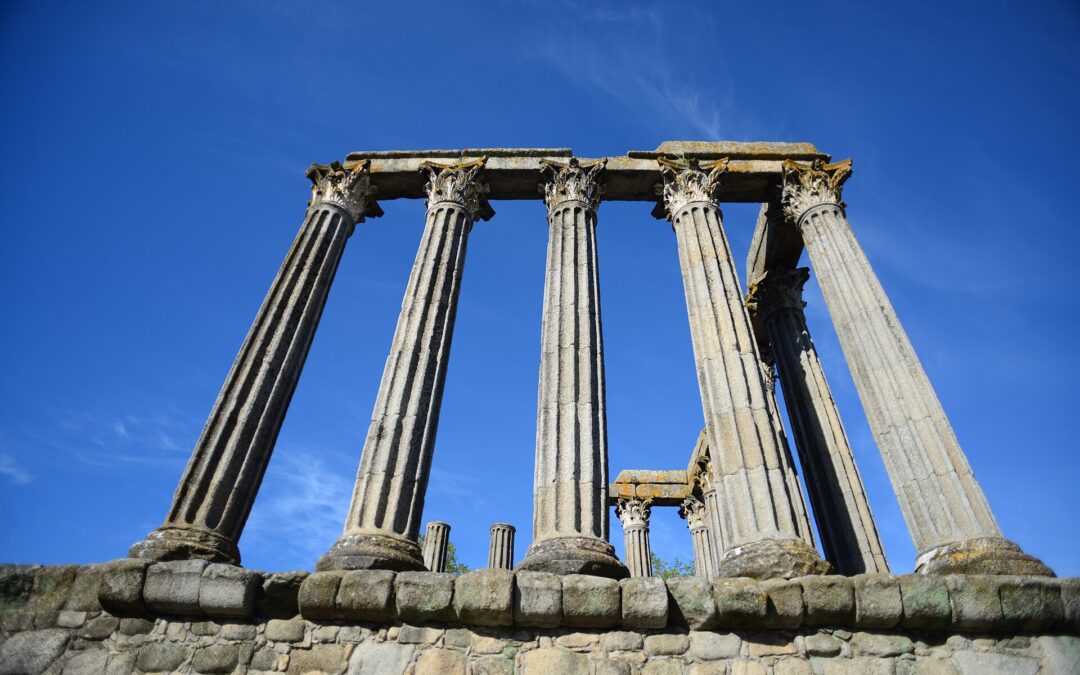
Featured photo: the Roman Temple of Évora. RSAlmeida / Wikimedia Commons, CC BY-SA 4.0
Right at the top of the old town stands the city’s icon: the Roman Temple of Évora, often called the Temple of Diana. Its tall Corinthian columns, built around two thousand years ago, rise from a granite platform in a small square, with no fences and no ticket. Children can walk all the way around it and imagine the forum that once surrounded it.
Tip: come back at sunset or after dark, when the columns are lit and glow golden against the sky. The gardens of the Jardim de Diana next door have a viewpoint over the plains.
The Cathedral and its rooftop
A few steps away is the Sé, the largest medieval cathedral in Portugal, built mainly in the 12th and 13th centuries in a mix of Romanesque and Gothic styles. Visit the Gothic cloister, then climb the narrow spiral stairs to the roof terrace. Walking across a cathedral roof is a real adventure for children, and because the Sé sits at the city’s highest point, the views over the terracotta rooftops and the Alentejo plains are superb.
Good to know: tickets are inexpensive, with combined options for the cathedral, cloister, roof and museum. The stairs are steep and narrow, so this is not one for pushchairs.
The Chapel of Bones (Capela dos Ossos)
Évora’s most famous, and most surprising, sight is the Capela dos Ossos inside the Church of São Francisco, a short walk south of the main square. Built by Franciscan monks in the 17th century, its walls and pillars are lined with thousands of human bones and skulls. Above the entrance an inscription greets visitors with a sobering message: “We bones that are here, await yours.”
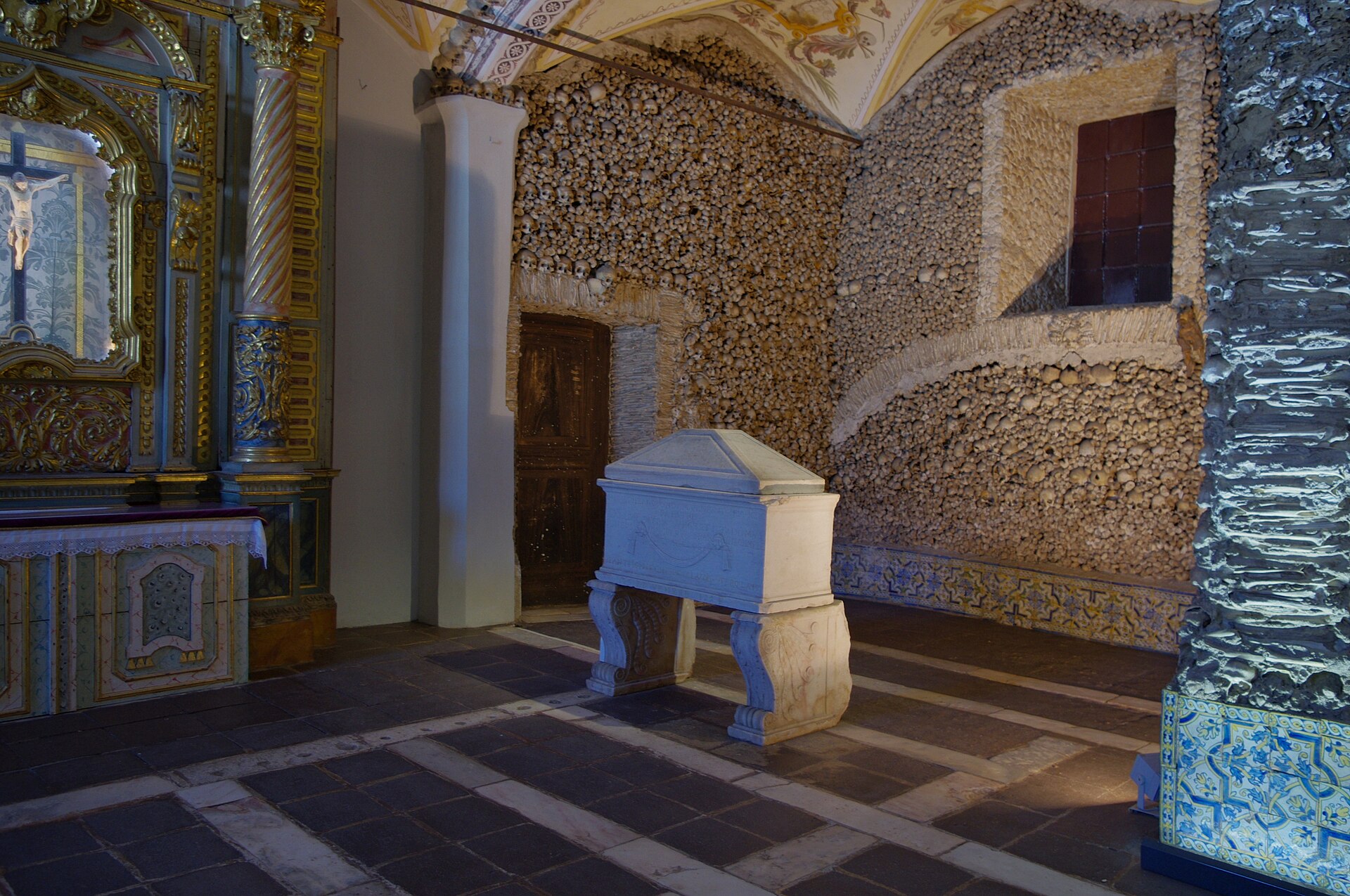
It was created as a reminder that life is short, and it is genuinely moving rather than gruesome. Still, think about your own children before you go: many school-age children find it fascinating, while younger or sensitive ones may find it frightening. The visit is short, and one parent can always wait in the church or the pretty gardens of the Jardim Público next door.
Practical: the church itself is free; the chapel and the museum areas need a ticket, with reductions for young people and seniors and free entry for young children. Hours are longer in summer than in winter.
Praça do Giraldo and the old town
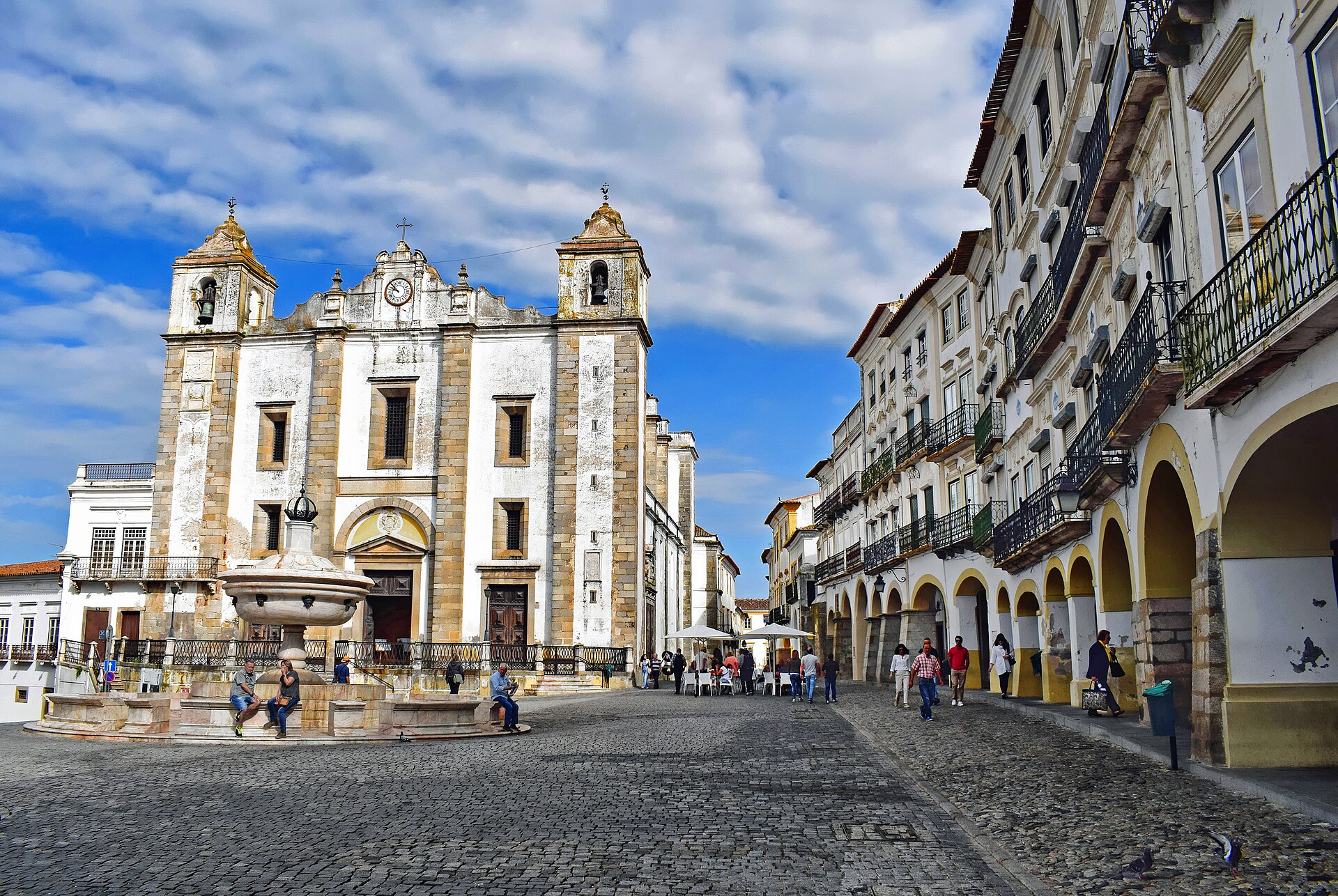
Praça do Giraldo is Évora’s living room: a long square framed by arcades, with a marble fountain at one end and the Church of Santo Antão behind it. From here, lanes fan out in every direction. Let the children lead and see where you end up: past whitewashed houses with yellow trims, under arches and through small squares.
Look out for the Aqueduto da Água de Prata, the 16th-century aqueduct whose arches run right into the old town, with small houses built between them, a fun “spot the house in the aqueduct” game for children. The University of Évora, one of the oldest in Portugal, has beautiful tiled classrooms, and the city walls make a pleasant evening walk.
Almendres Cromlech: older than Stonehenge
About 15 km west of Évora, among cork oaks and olive trees, stands one of the most extraordinary places in Portugal: the Cromeleque dos Almendres. Around 95 granite stones are arranged in a great oval on a gentle slope. They were raised in several phases during the Neolithic, thousands of years before Stonehenge, and were only rediscovered in 1966. It is the most important group of standing stones on the Iberian Peninsula.
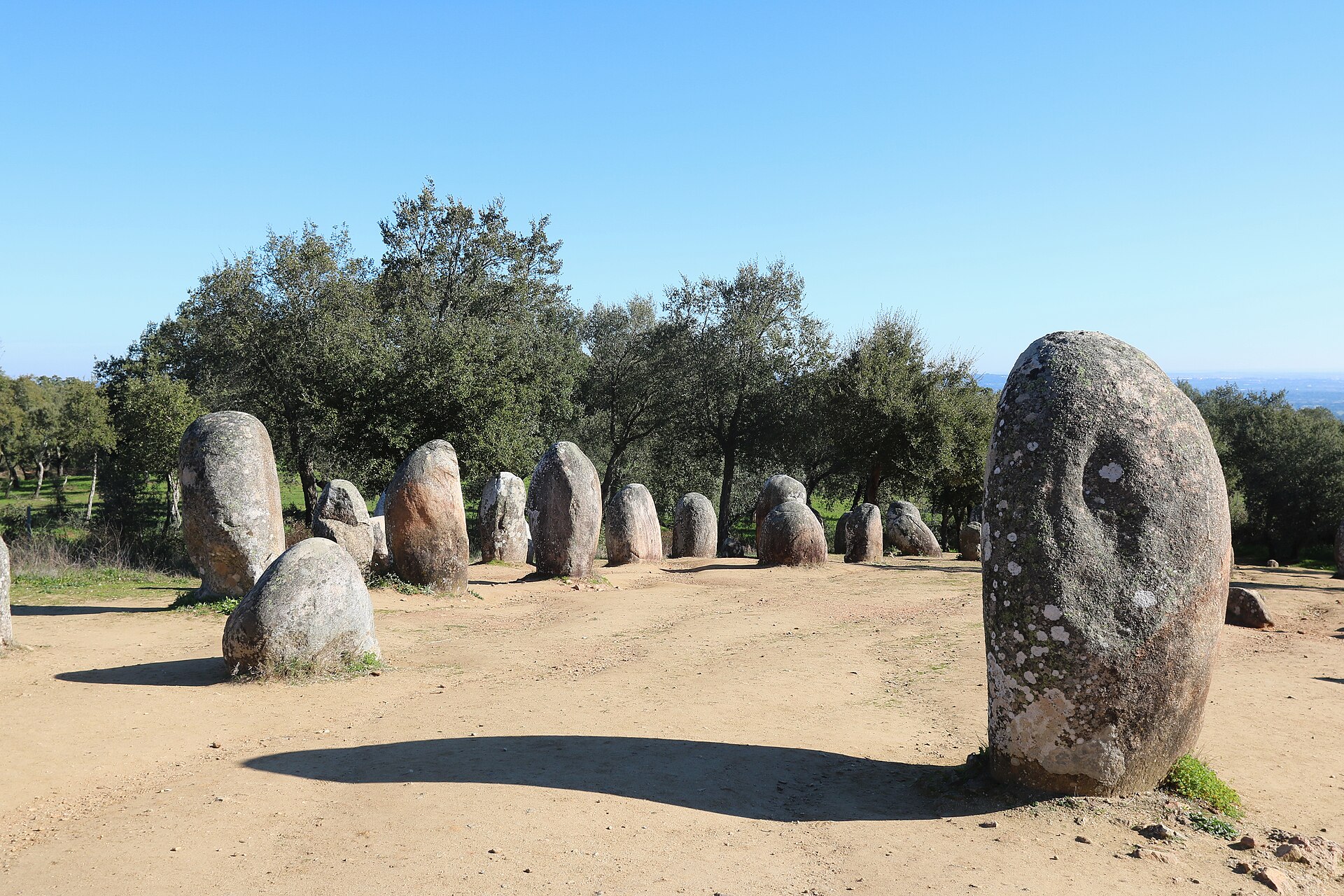
There is no ticket, no visitor centre and usually very few people, so children can walk around the circle, look for the faint carved symbols on some of the stones and wonder what they were for. A short walk away, the lone Menir dos Almendres stands in a field. Come early or late in the day for the best light.
Getting there: follow the road towards Montemor-o-Novo and turn off at the village of Guadalupe. The last stretch is an unpaved track, so drive slowly.
What to eat in Évora
The Alentejo is one of Portugal’s great food regions, and Évora is the place to try it:
- Porco preto: black Iberian pork, tender and full of flavour, often simply grilled.
- Migas: fried bread with garlic and olive oil, often served with pork.
- Açorda alentejana: a fragrant bread and coriander soup with a poached egg, simple and comforting.
- Queijo de Évora: a small, tangy sheep’s milk cheese.
- Convent sweets: egg-yolk and almond pastries such as pão de rala, a speciality of the city.
Lunch is the main meal, and many restaurants close between lunch and dinner, so plan snacks for the afternoon.
A simple plan for one day
- Morning: Roman Temple, then the cathedral, cloister and rooftop.
- Late morning: stroll down to Praça do Giraldo for a coffee and a pastry.
- Lunch: an Alentejo restaurant in the old town.
- Afternoon: Chapel of Bones and the Jardim Público, then follow the aqueduct.
- Late afternoon: drive out to the Almendres Cromlech for the golden hour.
With two days, add a trip to the hilltop village of Monsaraz, a winery visit for the adults, or a swim and picnic by the great Alqueva lake.
Practical information
- Getting there: Évora is roughly 1.5 to 2 hours from Lisbon by car, train or express bus. A car makes it easier to reach the Cromlech and the countryside.
- When to go: spring and autumn are ideal. Summers in the Alentejo are very hot, so in July and August sightsee early, rest at midday and go out again in the evening.
- Getting around: the old town is compact and walkable, but cobbled. A carrier is easier than a pushchair.
- Parking: park outside the walls and walk in; driving in the narrow lanes is stressful.
Where to stay
Stay inside the walls to step straight out into the old town in the evening, when the day-trippers have gone and the squares belong to locals. Évora has good family apartments and characterful small hotels in restored townhouses. For more space, consider a monte, a country estate in the surrounding plains, many with pools, gardens and farm animals. They are perfect for families in the warmer months.
Why Évora is worth it
Few places let children touch so many layers of history in a single day: Neolithic stones in the morning, a Roman temple at lunchtime, a medieval cathedral roof in the afternoon. Add the slow rhythm of the Alentejo, wonderful food and the excitement of a European Capital of Culture, and Évora is one of the most rewarding family trips in Portugal.